Document Structure
Every Teckel document is a YAML file with a defined set of top-level keys. This page explains what each key does and how they fit together.
Formal reference: Section 4 — Document Structure in the Teckel Specification.
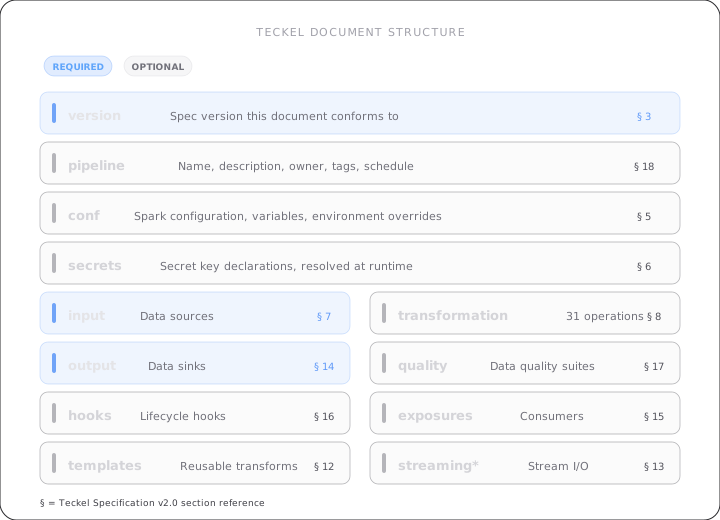
Skeleton Document
Here is a complete skeleton showing every top-level key with comments:
# REQUIRED -- spec version this document conforms to
version: "2.0"

# OPTIONAL -- pipeline-level metadata (name, description, owner)
pipeline:
  name: "my-pipeline"
  description: "What this pipeline does"
  owner:
    name: "Data Team"
    email: "data@example.com"

# OPTIONAL -- pipeline-wide configuration (Spark conf, variables, etc.)
config:
  spark:
    spark.sql.shuffle.partitions: 200

# OPTIONAL -- secret key declarations (resolved at runtime)
secrets:
  db_password:
    provider: env
    key: DB_PASSWORD

# OPTIONAL -- lifecycle hooks (run before/after the pipeline)
hooks:
  pre:
    - command: "echo 'Starting pipeline'"
  post:
    - command: "echo 'Pipeline complete'"

# OPTIONAL -- reusable transformation templates
templates:
  - name: standard-filter
    # ...template definition...

# OPTIONAL -- data quality check suites
quality:
  - suite: input-checks
    # ...checks...

# REQUIRED -- at least one data source
input:
  - name: raw_data
    format: csv
    path: "data/input.csv"

# OPTIONAL -- streaming data sources
streamingInput:
  - name: events
    format: kafka
    # ...streaming config...

# OPTIONAL -- transformation steps
transformation:
  - name: cleaned
    where:
      from: raw_data
      filter: "status IS NOT NULL"

# REQUIRED -- at least one data destination
output:
  - name: cleaned
    format: parquet
    path: "data/output/"
    mode: overwrite

# OPTIONAL -- streaming data destinations
streamingOutput:
  - name: events_out
    format: kafka
    # ...streaming config...

# OPTIONAL -- downstream consumer declarations
exposures:
  - name: dashboard
    type: dashboard
    # ...exposure config...
Required vs. Optional
Only three keys are required in every document:
| Key | Required | Purpose |
|---|---|---|
version | Yes | Declares which spec version this document targets. Must be "2.0". |
input | Yes | At least one data source. Without data to read, there is no pipeline. |
output | Yes | At least one data destination. The pipeline must write something. |
Everything else is optional. The simplest valid document has just version, one input, and one output.
Top-Level Keys at a Glance
version
A string that must be "2.0" for the current spec. This field exists so that tooling and runtimes can detect which version of the spec a document was written for.
version: "2.0"
input
A list of data sources. Each entry has a name, format, path, and optional options. See Inputs for the full reference.
transformation
A list of transformation steps. Each entry has a name and exactly one operation key (select, where, group, join, orderBy, etc.). Transformations reference other assets via the from field. See the Transformations section.
output
A list of data destinations. Each entry references an existing input or transformation asset by name and specifies where and how to write the data. See Outputs for details.
pipeline
Metadata about the pipeline itself — its human-readable name, a description, and an owner. This information is for documentation and governance; it does not affect execution.
config
Pipeline-wide configuration. This is where you put engine-specific settings (like Spark configuration) and define variables for use in ${...} substitution.
secrets
Declares secret keys that will be resolved at runtime from environment variables, vaults, or other providers. Referenced in the document via {{secrets.key_name}} placeholders.
hooks
Lifecycle hooks that run before (pre) or after (post) pipeline execution. Useful for setup, teardown, notifications, or validation scripts.
quality
Data quality check suites. Attach validation rules to your assets — null checks, uniqueness constraints, range checks, and more.
templates
Reusable transformation definitions that can be referenced elsewhere in the document, reducing duplication across similar pipelines.
streamingInput / streamingOutput
Streaming counterparts of input and output for real-time pipelines (e.g., Kafka sources and sinks).
exposures
Declarations of downstream consumers — dashboards, reports, ML models, or other systems that depend on this pipeline's output. This is metadata for lineage tracking, not executable logic.
Extension Keys
Any top-level key prefixed with x- is treated as an extension key. Runtimes that do not recognize an extension key will ignore it. This lets you add custom metadata without breaking compatibility:
x-team: platform-engineering
x-cost-center: "CC-1234"
Warning: Top-level keys that are not in the list above and do not start with
x-will cause a validation error. Teckel rejects unknown keys to catch typos early.
Processing Order
When a runtime executes a Teckel document, it processes the file in this order:
- Variable substitution —
${...}placeholders are replaced with values from config or environment. - Config merging — If multiple files are provided, they are merged.
- YAML parsing — The resolved text is parsed as YAML 1.2.
- Secret resolution —
{{secrets.*}}placeholders are resolved. - Schema validation — The document structure is checked against the spec.
- Semantic validation — Cross-references, types, and constraints are verified.
- DAG construction — The dependency graph is built from asset references.
- Pre-hooks —
hooks.precommands run. - Pipeline execution — The DAG is executed in topological order.
- Post-hooks —
hooks.postcommands run.
Note: Textual order within the YAML file has no effect on execution. A transformation listed first can depend on one listed last. The runtime resolves everything through the DAG.