Quality Suites
Teckel provides a declarative data quality system through the top-level quality section. Quality checks are organized into suites, each scoped to a specific asset in the pipeline DAG.
Formal reference: Section 17 — Data Quality in the Teckel Specification.
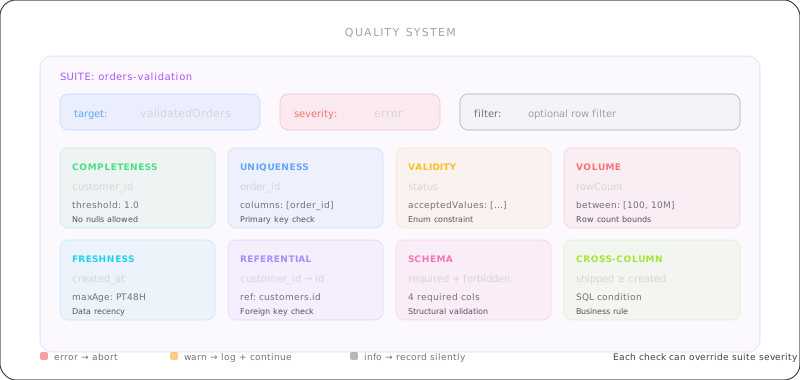
Suite Structure
A quality suite groups related checks that validate a single dataset. Every suite targets one asset and contains one or more checks.
quality:
  - suite: <string>
    description: <string>
    target: <AssetRef>
    filter: <Condition>
    severity: <string>
    checks:
      - ...
| Field | Type | Required | Default | Description |
|---|---|---|---|---|
suite | string | Yes | — | Suite name, used in reporting and check results. |
description | string | No | — | Human-readable description of what this suite validates. |
target | AssetRef | Yes | — | The asset to validate. Must reference an asset defined in the pipeline. |
filter | Condition | No | — | Optional row filter. When provided, checks apply only to matching rows. |
severity | string | No | "error" | Default severity for all checks in this suite. One of "error", "warn", or "info". |
checks | NonEmptyList[Check] | Yes | — | The quality checks to apply. At least one check is required. |
Scoping to Assets
The target field binds the suite to a specific asset. This can be any asset in the pipeline: an input, a transformation, or an output reference.
quality:
  - suite: raw-data-checks
    target: rawOrders        # validates the rawOrders asset
    checks:
      - type: volume
        rowCount:
          min: 1
You can define multiple suites targeting the same asset, or spread checks across different suites for organizational clarity.
Row Filters
The filter field restricts which rows are evaluated. This is useful when checks should only apply to a subset of the data.
quality:
  - suite: premium-customer-checks
    target: customers
    filter: "tier = 'premium'"
    checks:
      - type: completeness
        column: account_manager
        threshold: 1.0
      - type: validity
        column: credit_limit
        range:
          min: 10000
In this example, completeness and validity checks run only against rows where tier = 'premium'.
Suite-Level Severity
The severity field sets the default severity for every check in the suite. Individual checks can override this default (see Severity and Thresholds).
The three severity levels control pipeline behavior on check failure:
| Severity | Behavior |
|---|---|
error | Pipeline aborts. |
warn | Warning is logged. Pipeline continues. |
info | Metric is recorded silently. Pipeline continues. |
Relationship to Assertions
The quality section is separate from the inline assertion transformation (Section 8.28 of the spec). The assertion transformation is a single-asset quality gate embedded directly in the DAG. The quality section is the recommended approach for comprehensive validation — it supports multiple quality dimensions, thresholds, severity levels, statistical checks, freshness validation, and cross-asset referential integrity.
Implementations should support both mechanisms.
Complete Suite Example
The following example defines a suite that validates an orders dataset with checks spanning several quality dimensions.
quality:
  - suite: orders-validation
    description: "Comprehensive quality checks for the orders dataset"
    target: validatedOrders
    severity: error
    checks:
      # Structural validation
      - type: schema
        columns:
          required: [order_id, customer_id, amount, created_at]
          forbidden: [internal_id]

      # No nulls allowed in the primary key
      - type: completeness
        column: customer_id
        threshold: 1.0

      # Order IDs must be unique
      - type: uniqueness
        columns: [order_id]

      # Status must be from a known set
      - type: validity
        column: status
        acceptedValues: [pending, confirmed, shipped, delivered, cancelled]

      # Positive amounts only
      - type: validity
        column: amount
        range:
          min: 0
          strictMin: true

      # Reasonable row count
      - type: volume
        rowCount:
          between: [100, 10000000]

      # Data must be recent
      - type: freshness
        column: created_at
        maxAge: "PT48H"

      # Foreign key to customers
      - type: referential
        column: customer_id
        reference:
          asset: customers
          column: id

      # Business logic: shipping after creation
      - type: crossColumn
        condition: "shipped_at IS NULL OR shipped_at >= created_at"
        description: "Shipping date must be after order creation"
This suite runs all checks against validatedOrders. Any failing check with error severity aborts the pipeline. Individual checks can override severity to warn or info for softer enforcement.